Instagram is not a website: why your business needs its own
Instagram is great for attention and poor for decisions. What you lose when your profile is your only address online, and how to make the two work together.
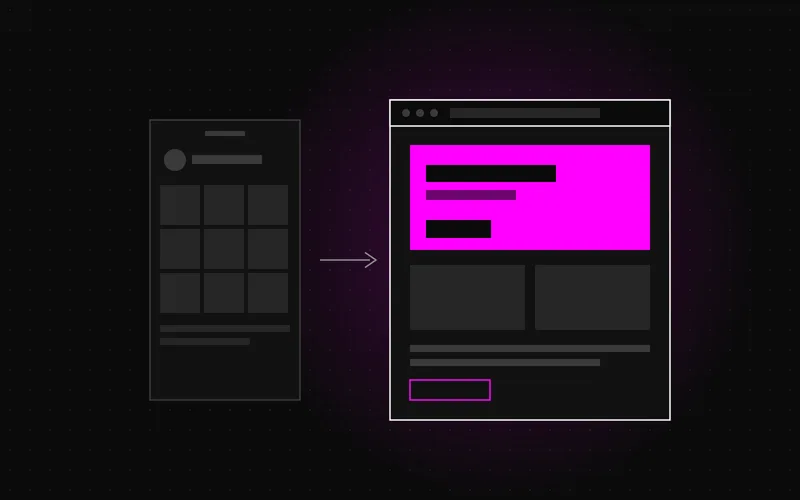
Plenty of small businesses run entirely on Instagram and Facebook. It makes sense: it's free, it's quick, and the customers are already there. But when a profile is the only place you exist online, you pay for it in ways that don't show straight away.
You're renting, not owning
Your Instagram profile isn't yours. The rules, the layout, who sees your posts and whether your account works at all are all decided by Meta. A hacked or wrongly suspended account can leave you overnight without the channel every enquiry comes through, and support for small accounts is practically out of reach.
A website on your own domain is an asset. You decide what it says, how it looks and who has access, and it stays yours when the algorithms change.
People look for you on Google, not on Instagram
When someone urgently needs a plumber, they don't open Instagram; they ask Google. Your posts mostly won't rank for "plumber in [your town]", but a well-built page with your services and location can. On top of that, AI assistants build their answers from content they can read, and a clearly written site is a far better source for them than a stream of photos with captions.
Information belongs in one place
Prices in one post, opening hours in a highlight, the address in your bio, a menu in a photo from last year. The information is on the profile, but it's scattered and quickly goes stale. A customer who can't find it in five seconds goes to a competitor.
A site has a fixed structure: services, prices or a price range, location, contact. Always in the same place, always up to date.
Trust
For many customers, especially those who got a referral or are looking for someone to do a bigger job, your own site and an email address on your own domain signal a business that's serious. For working with companies abroad, it's practically a requirement.
Side by side
| Your own site | ||
|---|---|---|
| Who owns it | Meta | You |
| Found through Google | Rarely | Yes, if it's built well |
| Reach depends on | The algorithm | You and search |
| Prices, hours, services | Scattered across posts | In one place |
| Enquiry form, booking | Limited | Whatever you need |
| If the account disappears | You lose everything | The site stays |
Not "or" but "and"
I'm not telling you to shut down Instagram. For stories, new work and day-to-day contact it's excellent. What works best is splitting the roles:
- Instagram catches attention and shows the atmosphere.
- Your site helps someone decide and get in touch: what you offer, roughly what it costs, where you are and how to reach you.
Point the link in your bio to your site, and give the site a WhatsApp button and a short form. Then the path from "I like this" to "I'm getting in touch" is a single tap.
How much site is enough
You don't need a big website to start. One well-made page with your services, a few real photos, your location, opening hours and contact details covers most of what a customer is looking for. It's easy to grow later.
See what it looks like when it's done properly in my work. If you'd like to talk about yours, get in touch.